




Cookies help us deliver our services. By using our services, you agree to our use of cookies.
- Register
- Log in
-
Shopping cart
(0)
You have no items in your shopping cart.
Search
FIRST Componens Academy | Visualizing Sound: PMOLED Displays for Next-Generation Audio
Tuesday, February 10, 2026
From Winstar News of February '26
Visualizing Sound: Why High-Contrast PMOLED Displays Are Powering the Next Generation of Audio Equipment
Introduction
Redefining the interface of Guitar Pedals, Synthesizers, and Hi-Fi Systems with "Pure Black" Aesthetics.
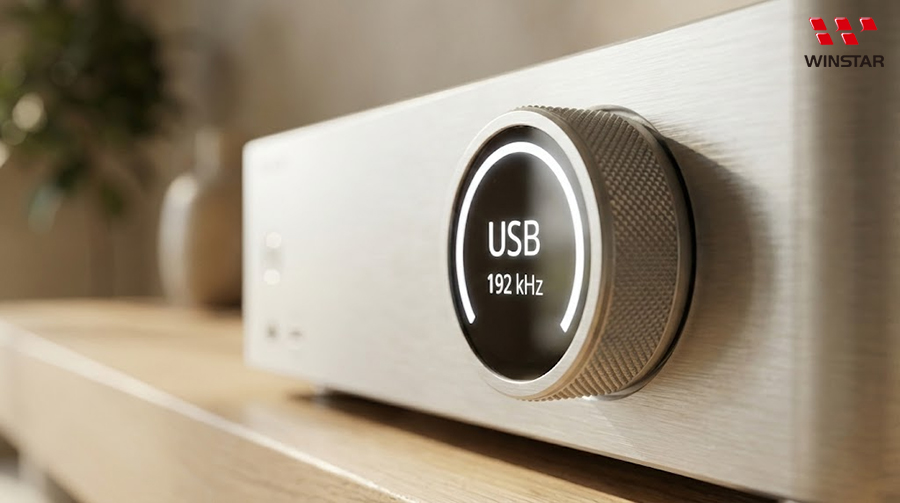
In the world of high-fidelity audio and professional music gear, "silence" is never empty—it is the ultimate form of control. Whether it's an audiophile chasing the lowest possible noise floor or a musician on a dimly lit stage needing to confirm tone settings in a split second, the display interface must never dominate; it must seamlessly become part of the sound itself.
This is the prevailing design trend in high-end audio equipment: Information should appear vividly when needed and vanish into the design when it is not.
With its self-emissive properties, high contrast, true black background, and ultra-thin profile, PMOLED (Passive Matrix OLED) is rapidly becoming the industry standard. WINSTAR, a long-time specialist in PMOLED modules and system integration for audio applications, helps global brands transform abstract sound data into intuitive, premium visual experiences within limited front-panel spaces.
Why Is PMOLED Becoming the Standard for Audio Equipment?
For product managers and engineering teams, the battleground for audio products has shifted beyond mere specifications. It is now about achieving the perfect balance between aesthetic design, instant feedback, and signal purity.
PMOLED delivers three decisive advantages for audio devices:
1. Pure Black Aesthetics | The Display That Vanishes
The self-emissive nature of PMOLED eliminates backlight bleeding, achieving profound blacks and an ultra-high contrast ratio (>10,000:1).
• Seamless Integration: In standby mode, the panel blends perfectly with black aluminum or brushed metal casings, creating an "Invisible Screen" effect.
• Floating Visuals: When active, text and graphics appear to float on the device's surface. For Hi-Fi systems and DACs (Digital-to-Analog Converters) that
prioritize minimalist design, this maintains the integrity of the product's visual language.
2. Instant Synchronization | Zero Ghosting, Real-Time Feedback
Music is a fluid art; the screen must keep up with the rhythm. PMOLED's lightning-fast response time (typically <10µs at 25°C) is ideal for dynamic content:
• Live Status Feedback: VU meters, spectrum analyzers, and clip/overload indicators are rendered with absolute clarity and zero motion blur.
• Operational Confidence: When visual changes sync perfectly with the sound, users gain an intuitive grasp of the device status, significantly enhancing
professional trust.
3. Noise-Aware Integration | Engineered for Audio-Sensitive Environments
In high-sensitivity audio equipment, the key to system design is not just suppressing noise sources, but preventing the introduction of interference. Traditional backlit displays often require PWM dimming and high-speed driving signals, which pose EMI/EMC risks.
• Cleaner Architecture: PMOLED uses a self-emissive structure that requires no backlight and no PWM dimming. This simpler driving architecture is easier
to control.
• Signal Purity: This characteristic lowers the risk of interference during system integration, allowing the display module to coexist stably with high-sensitivity
analog circuits (such as preamps or DACs), ensuring a pristine audio experience.
Field Applications | How WINSTAR Redefines the Audio Experience
1. The Stage Legend: Guitar Effects Pedals / Stompboxes
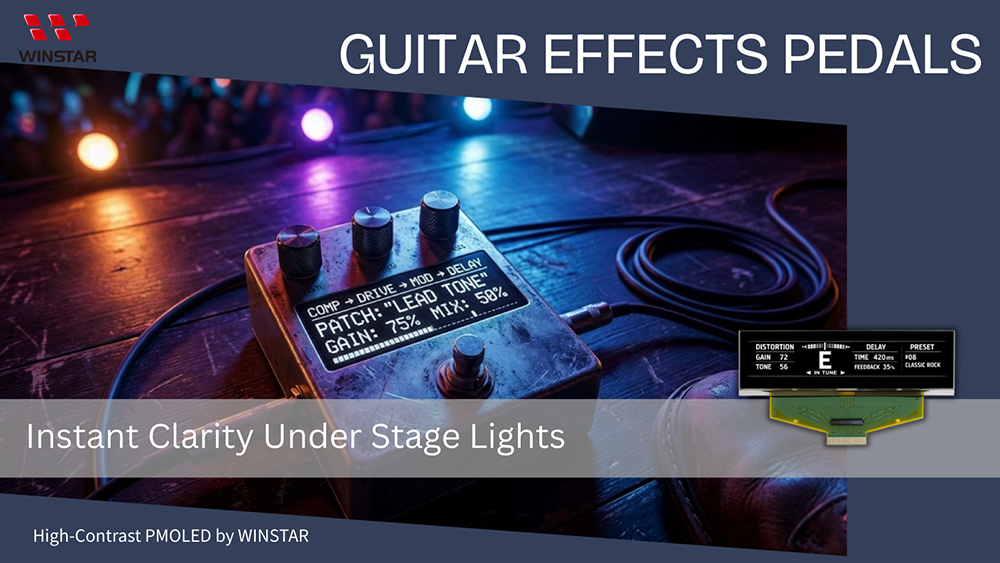
Amidst the chaos of stage lighting, a musician has only 0.5 seconds to make a decision.
• The Challenge: Musicians need instant clarity. Traditional 7-segment displays often distort or become unreadable under harsh stage lights, smoke, or
off-axis viewing angles.
• The PMOLED Solution:
→ Ultra-Wide Viewing Angles: Whether the musician is standing over the board or crouching to tweak a knob, PMOLED remains sharp from any angle.
→ Intuitive Visualization: Tuner status, effect names, and parameters are displayed graphically for at-a-glance recognition.
→ Flexible Integration: Custom FPC shapes navigate around tight footswitch and jack configurations.
• Expert Insight: For stompboxes, the display must be readable in 0.5 seconds under any lighting condition and survive rigorous use. WINSTAR's PMOLED
modules undergo professional vibration testing to ensure reliability in rugged touring environments.
2. The Composer's Tool: Electronic Keyboards / Synthesizers
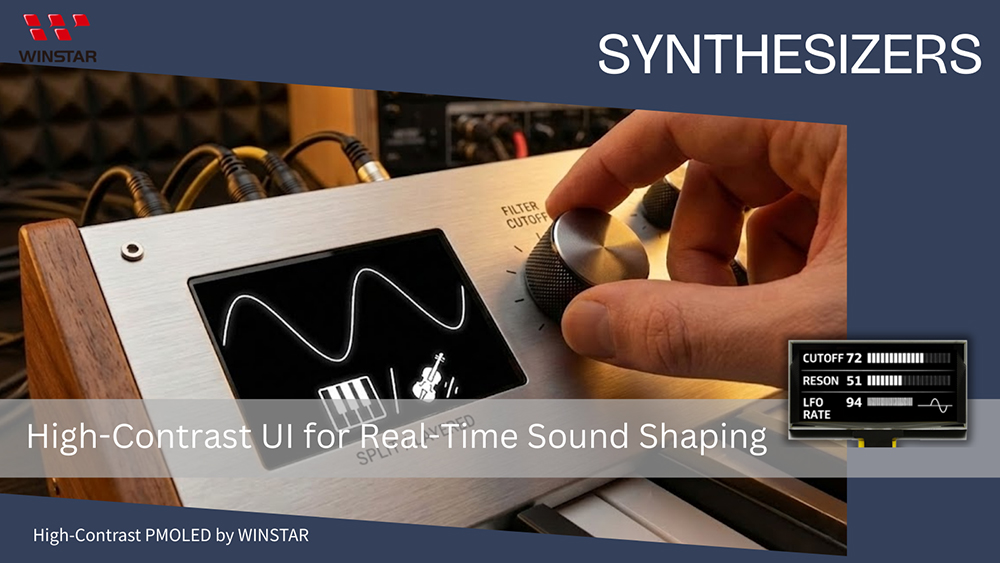
Don't let complex parameters interrupt the flow of inspiration.
• The Challenge: Modern synths are powerful, but limited screens force users to navigate through endless menus, interrupting the creative workflow.
• The PMOLED Solution:
→ True Black & High Contrast: Legible in bright stage lights or dark studios without straining the eyes.
→ Dynamic Feedback: Visualizing filter/envelope changes in real time allows users to "see" the sound-shaping process.
→ High-Speed Response: Eliminates ghosting, ensuring smooth visuals even during fast-paced performances.
• Expert Insight: WINSTAR helps brands optimize font rendering, animation details, and guided visuals (e.g., dynamic filter arrows and MOD routing flows) to
ensure the UI acts as a seamless extension of the musician's hands.
3. The Audiophile: Hi-Fi Audio Systems / DACs
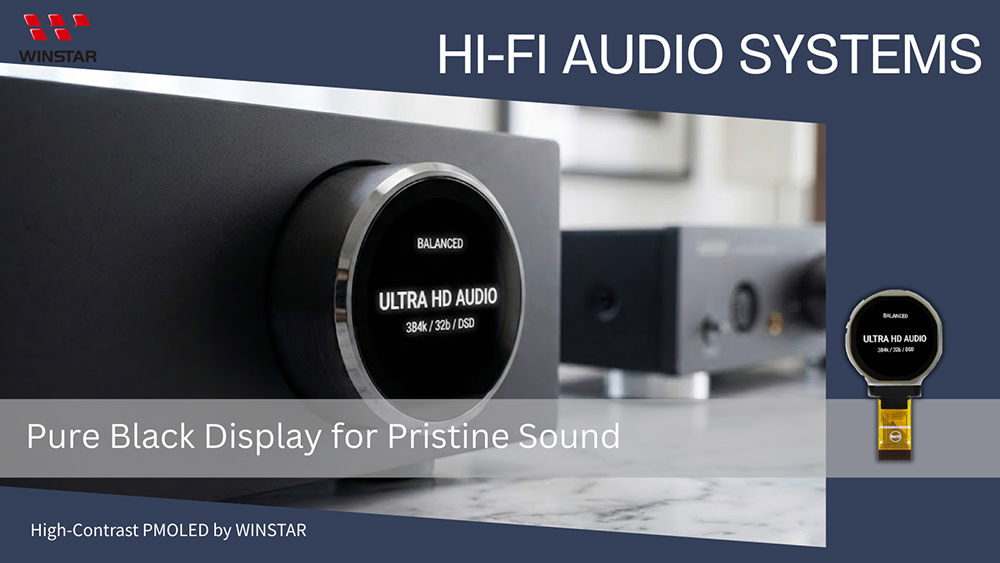
The screen shouldn't be a distraction; it should be an extension of craftsmanship.
• The Challenge: High-end Hi-Fi equipment is defined by material quality and tactile feel. A generic display can look out of place and ruin the premium
aesthetic.
• The PMOLED Solution:
→ Invisible Bezel: Utilizing "Pure Black" technology, the screen disappears when idle and text "floats" when active.
→ Minimalist Elegance: A single knob paired with a PMOLED module can elegantly display sample rate, input source, and bit depth without button
clutter.
• Expert Insight: WINSTAR understands the sensitivity of Hi-Fi circuits. The company provides EMI and grounding optimization to ensure the display module
introduces zero noise floor to the analog output.
4. The Pro: Wireless Microphones / Audio Interfaces
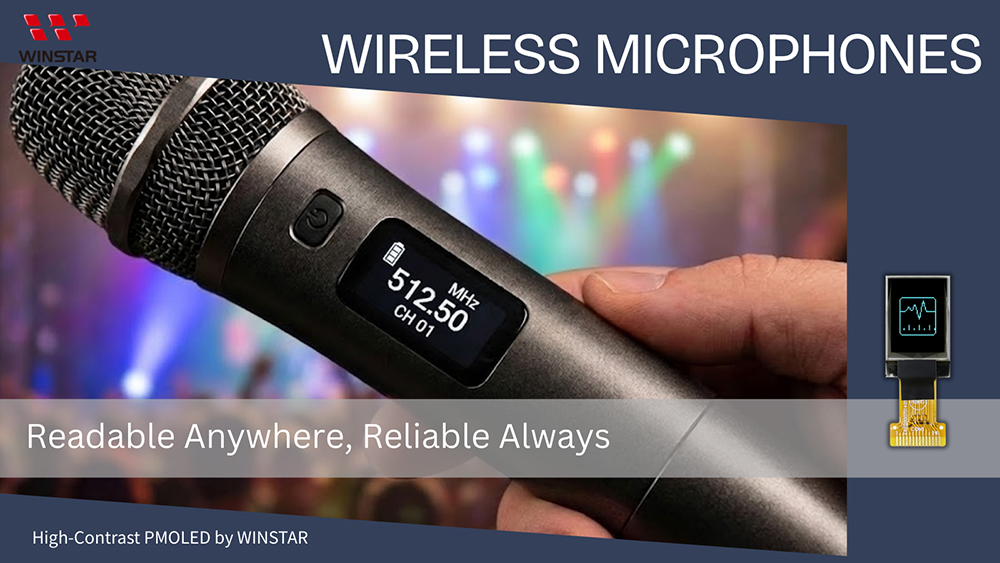
In critical moments, data accuracy is a lifeline.
• The Challenge: Handheld wireless microphones have zero space to spare, yet battery life and RF signal status must never be misread, indoors or
outdoors.
• The PMOLED Solution:
→ Ultra-Compact & Thin: Modules as small as 0.71" free up critical space for batteries and antennas.
→ All-Weather Readability: High contrast ensures RF/AF levels and mute status are legible even in direct sunlight.
• Expert Insight: For high-RF environments, WINSTAR optimizes FPC shielding and layout to minimize potential interference between the display driver and
wireless signals, ensuring rock-solid transmission.
Recommended PMOLED Models for Audio Equipment
Looking for the perfect fit? Here are the top recommendations based on device type:
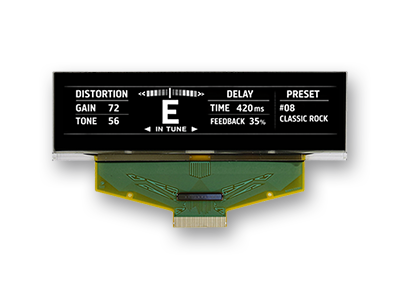
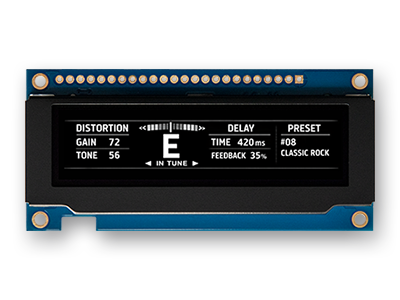
1. For Guitar Effects Pedals / Stompboxes
2.8-inch Bar Type PMOLED (256×64)
• Dimensions: Active Area ~69 × 17 mm
• Why it works: Perfect for a pedal-width main screen.
• Ideal for displaying: Effect signal chains, patch names, simplified VU/spectrum visuals.
Model No.:
 |
 |
| WEX25664*#A |
WEN25664*#A |
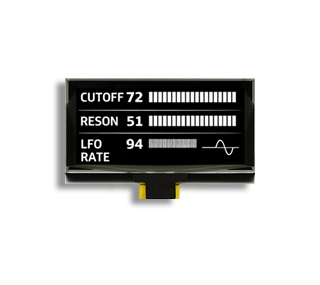
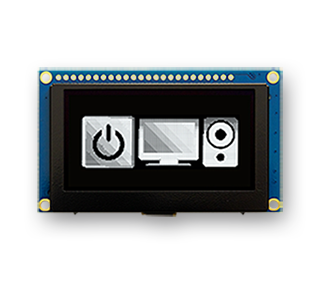
2. For Synthesizers / Keyboards
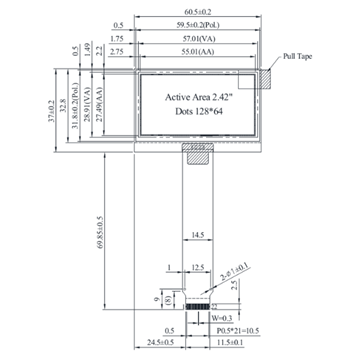
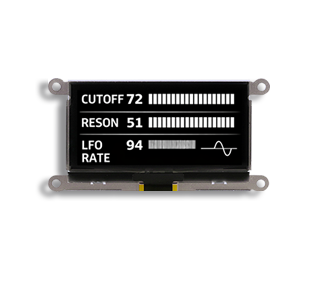
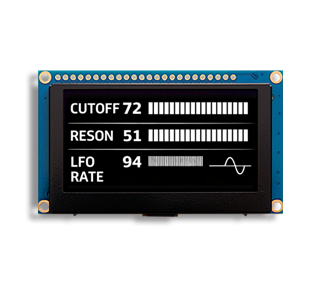
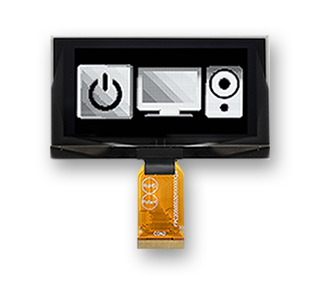
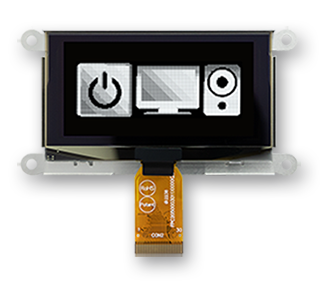
2.7-inch Large-Format PMOLED (128×64)
• Dimensions: Active Area ~61 × 30 mm
• Why it works: Strong visual presence for main UI design.
• Ideal for displaying: Layer/split UI, waveforms, step sequencer bars.
Monochrome Series
Model No.:
 |
 |
 |
| WEO12864*#Q |
WEF12864*#Q | WEP12864*#Q |
Gray Level Series
Model No.:
 |
 |
 |
| WEO12864*#U |
WEF12864*#U | WEP12864*#U |
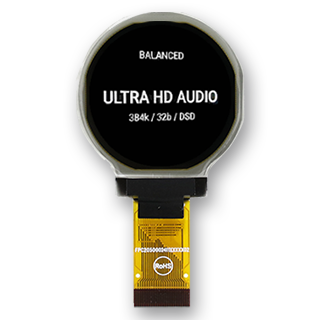
3. For Hi-Fi Audio / DACs
1.18-inch Circular PMOLED (128×128)
• Dimensions: Active Area Ø30 mm
• Why it works: Integrates perfectly with rotary knobs.
• Ideal for displaying: Volume rings, sample rate, input source.
Model No.:
 |
| WEO128128*#B |
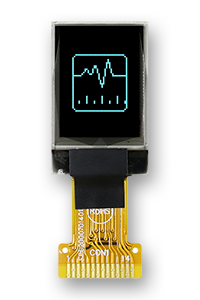
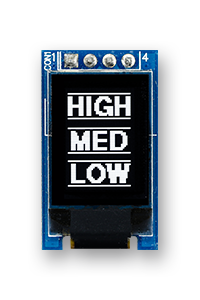
4. For Professional Wireless Microphones
0.71-inch Narrow-Bezel PMOLED (48×64)
• Dimensions: Active Area 10.54 × 14.7 mm
• Why it works: Vertical layout for quick thumb-check visibility.
• Ideal for displaying: Battery, RF level, channel, mute/lock icons.
Model No.:
 |
 |
| WEO4864*#A | WEA4864*#A |
Is Your Sound Ready to be Seen?
How can we help you?
• Free Evaluation: We recommend the optimal PMOLED size and specifications based on your mechanical drawings.
• Sample Support: Rapid delivery of samples and demo kits for validation.
• Mass Production Commitment: Stable supply plans and long-term quality assurance.